Recent analyses from the National Highway Traffic Safety Administration (NHTSA) highlight a stark reality in traffic safety: jaywalking pedestrian accidents at night dominate fatal pedestrian incidents, accounting for a significant portion of the over 7,300 pedestrian deaths reported in 2023 alone. In 2023, 77% of all pedestrian fatalities occurred in dark conditions, underscoring how reduced visibility amplifies risks when pedestrians cross outside designated areas. This trend persists despite overall declines in some traffic fatalities, as nighttime jaywalking pedestrian accidents reveal deeper issues in urban design, driver behavior, and pedestrian choices.
Nighttime Dominance in Pedestrian Fatalities
Data from NHTSA’s Fatality Analysis Reporting System (FARS) shows that 77% of pedestrian deaths in 2023 happened after dark, compared to just 19% in daylight hours. This disparity stems from visibility challenges, where drivers struggle to detect pedestrians until it’s too late, especially on unlit roads or arterials far from city centers. Nearly two-thirds of pedestrian fatalities nationwide occur at night, with an 84% rise in such crashes from 2010 to 2023, far outpacing daytime increases.
The evening rush exacerbates this, as 26% of all pedestrian deaths cluster between 6 p.m. and 8:59 p.m., transitioning into even darker hours. Urban areas bear the brunt, with 84% of 2023 fatalities in cities where streetlights often fail to illuminate mid-block crossings. These patterns indicate that nighttime jaywalking pedestrian accidents thrive in environments prioritizing vehicle flow over pedestrian paths, leading to predictable yet preventable tragedies.
Defining Jaywalking in Legal Contexts
Jaywalking legally constitutes crossing a roadway outside marked crosswalks, against signals, or in ways disregarding traffic flow, as codified in state vehicle codes modeled after uniform standards. Most jurisdictions classify it as an infraction carrying fines up to $100 or more, though some like Nevada impose civil penalties without criminal misdemeanor status. Courts assess liability through comparative negligence doctrines, where jaywalkers may share fault but drivers retain primary duty to yield in low-visibility scenarios.
Judicial precedents emphasize that even illegal pedestrian actions do not absolve drivers of vigilance, particularly at night when headlights must scan for unexpected movements. Recent reforms in states like California decriminalize minor jaywalking unless it endangers traffic, shifting focus to infrastructure deficits that force such behavior. This evolution reflects broader recognition that jaywalking pedestrian accidents often signal systemic failures rather than isolated recklessness.
Jaywalking’s Prominent Role in Night Crashes
Studies pinpoint jaywalking as a factor in 20% of all U.S. pedestrian fatalities, surging at night due to shortcuts across state highways and local streets lacking crosswalks. California leads with 942 jaywalking-related deaths over five years, while Colorado shows the highest proportion at 56% of pedestrian crashes, many unfolding after dark. Phoenix emerges as the deadliest city, with 260 such fatalities, 92% on local streets where poor lighting hides pedestrians darting mid-block.
FARS data corroborates that 74% of nighttime pedestrian deaths occur away from intersections, prime zones for jaywalking pedestrian accidents. Alcohol compounds this, present in 46% of fatal pedestrian crashes, impairing both parties’ judgment during evening hours. Males aged 30-44 dominate victims, with rates peaking for those 55-59 at 3.13 per 100,000, often linked to after-work crossings without signals.
Visibility Challenges Fueling Nighttime Risks
Diminished sightlines at night reduce reaction times, turning routine jaywalking pedestrian accidents into catastrophes on multi-lane arterials. NHTSA notes 76% of dark-hour fatalities involve no street lighting or inadequate illumination, a factor unchanged despite rising pedestrian volumes. Research from the AAA Foundation reveals nearly all post-2009 fatality spikes happened on urban arterials after sunset, disproportionately in low-income areas with sparse infrastructure.
Shorter days post-Daylight Saving Time spike risks further, as drivers adjust to earlier dusk amid faster evening traffic. Front-end vehicle impacts claim 85% of single-vehicle nighttime deaths, confirming pedestrians step unexpectedly into headlight beams. These dynamics persist across seasons, with summer seeing peaks from 9 p.m. to midnight due to prolonged activity in dim conditions.
Urban Arterials as Hotspots for Fatalities
Arterial roads host half of nighttime jaywalking pedestrian accidents, designed for speed with minimal pedestrian aids like islands or signals. State highways account for 28% of jaywalking deaths nationwide, local streets 26%, both amplified at night without reflective signage or bollards. Cities like Phoenix and Tucson show 80-90% of such incidents on these stretches, where wide lanes encourage risky mid-block dashes.
NHTSA’s 2023 report flags 89% of pedestrian fatalities as single-vehicle events, often hit-and-runs (24% overall), evading accountability in shadows. Economically burdened neighborhoods suffer most, lacking funds for retrofits despite high walkability needs near transit. Why jaywalking is a common factor in pedestrian accidents, as explored in detailed analyses, ties directly to these arterial vulnerabilities.
Demographic Vulnerabilities Exposed by Data
Males comprise 70% of nighttime pedestrian deaths, with ages 40-44 hitting 674 fatalities in 2023, their evening commutes clashing with post-rush traffic. Older adults (65+) represent 19% of victims, their slower reflexes ill-suited to dark crossings without aids. Youth under 15 fare better at 17% of total child deaths but cluster in urban evenings near poorly lit paths.
Alcohol-impaired pedestrians (BAC 0.08+) factor in 30% of nighttime fatalities, peaking for 21-24-year-olds at 40%. Hit-and-run rates soar in these demographics, as drivers flee unlit scenes fearing bias in jaywalking disputes. Regional disparities shine through: New Mexico’s 4.97 rate per 100,000 dwarfs Nebraska’s 0.66, tied to arid nights and sparse signals.
Alcohol’s Amplifying Effect at Night
Nighttime jaywalking pedestrian accidents intertwine with substance use, as 46% of 2023 fatal crashes involved impaired drivers or pedestrians. Evening peaks from 9 p.m. to midnight see 35% of summer deaths, when bar closings spur impaired crossings. NHTSA estimates BACs confirm 16% driver impairment and 30% pedestrian, blurring fault lines in low-light claims.
Courts parse this via blood tests and witness accounts, often reducing driver liability if jaywalking initiated peril. Yet, 23% hit-and-runs shield precise attribution, leaving families navigating comparative fault statutes. Transitional reforms prioritize sobriety checks over blanket jaywalking tickets, recognizing alcohol’s role in visibility-blind decisions.
Infrastructure Gaps and Engineering Insights
Poor lighting on 76% of fatal sites demands FHWA countermeasures, like full-spectrum LEDs cutting nighttime rates threefold. The absence of crosswalks on arterials forces jaywalking, as seen in Phoenix’s six-lane voids breeding 260 deaths. Retaining walls or medians could halve mid-block risks, per AAA studies of disadvantaged zones.
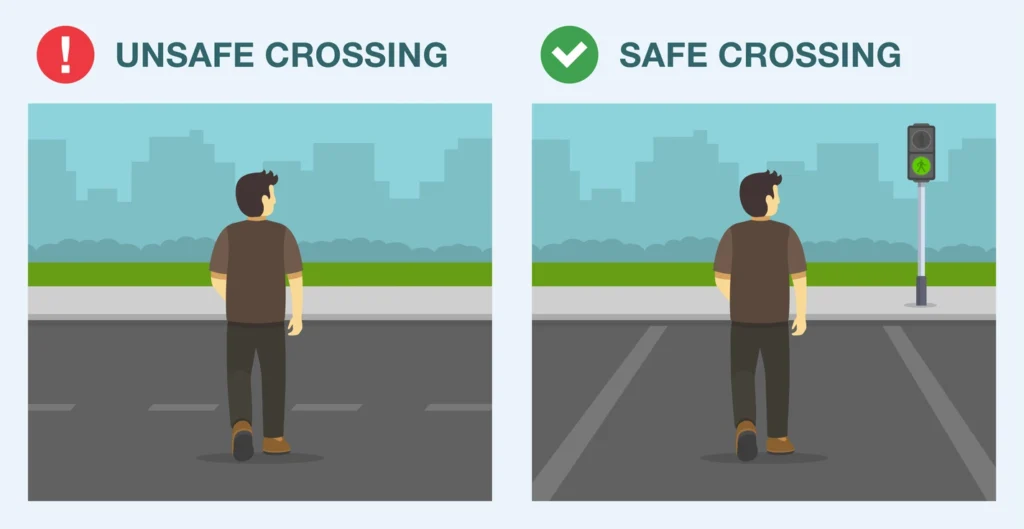
NHTSA urges retrofits prioritizing “safe speeds” via chicanes and signals, aligning with Vision Zero judicial standards holding cities accountable. Data shows 74% non-intersection deaths plummet with zebra crossings and refuge islands, directly curbing nighttime jaywalking pedestrian accidents. For authoritative insights, the NHTSA pedestrian safety guidelines detail evidence-based designs proven to enhance dark-hour survival.
Seasonal and Temporal Patterns in Crashes
Winter evenings claim 34% from 6-9 p.m., as early dusk catches workers jaywalking homeward. Summer shifts later, with 35% past 9 p.m., blending heat, crowds, and fatigue on unlit paths. Weekends amplify risks, 28% from 9 p.m. to midnight, when social outings lead to impaired jaywalking pedestrian accidents.
Fall post-DST surges mimic spring dawn perils, both at 20-32% in peak slots, underscoring clock shifts’ role in visibility drops. FARS temporal breakdowns reveal consistent evening dominance, urging timed lighting surges at high-risk hours.
Vehicle Dynamics in Nighttime Collisions
Light trucks, including SUVs, struck 3,016 pedestrians fatally in 2023, 90% front impacts in dark single-vehicle crashes. Passenger cars follow at 2,020, their lower profiles missing elevated jaywalkers until collision. Buses show higher side strikes (20-24%), as passengers disembark into traffic shadows.
Hit-and-runs hit 24%, 91% single-vehicle, fleeing unlit scenes where jaywalking muddies narratives. Speed exacerbates, with arterials’ 35-45 mph norms shattering reaction windows under 2 seconds at night.
State Variations and Policy Responses
California’s 1,106 deaths lead, 27% of totals, fueled by vast arterials and lax enforcement. Arizona’s Phoenix-Tucson duo claims 144, with 45-56% jaywalking shares on dim locals. Reforms decriminalize safe jaywalking, fining only imminent threats, per Nevada-California models.
High-rate states like New Mexico push FHWA grants for lighting, slashing 58% dark fatalities since 2010 pilots. Low-rate Nebraska leverages rural-urban mixes, minimizing mid-block exposures.
Evolving Legal Standards Post-Accident
Courts apply pure comparative negligence in most states, apportioning fault where jaywalking meets driver lapses like speeding. Nighttime evidence—dashcams, witnesses, forensics—weighs heavily, often capping pedestrian recovery at 50% fault. FARS aids reconstructions, proving visibility breaches trump illegal crossings.
Virginia uniquely shields crosswalk users from jaywalking defenses, extending to night via strict yield mandates. Trends favor infrastructure suits against municipalities, as data links unlit roads to foreseeable jaywalking pedestrian accidents.
Future Directions from Crash Analyses
NHTSA’s safe systems prioritize roads forgiving errors, like adaptive headlights cutting dark risks. Integrating equity metrics targets burdened tracts with 80% fatality hikes. Pilots blending AI signals and retroreflective gear promise 30% drops in nighttime jaywalking pedestrian accidents.
Holistic reforms—decriminalization, lighting mandates, speed cameras—align data with judicial evolution, fostering streets where night holds no terror.